Of the six great hadith collections that Sunni Muslims have relied on for over a thousand years, one was compiled by a scholar from a frontier town on the edge of Persia. His name was Imam Ibn Majah, and his book, Sunan Ibn Majah, holds a place no other collection fills: a large body of authentic narration reaches us through it and through no other book.
This article draws on Dar-us-Salam's Imam Ibn Maajah from the Biography of the Imams series. It covers who he was, how he studied, what makes his Sunan distinctive, and why scholars eventually counted it among the Kutub al-Sittah.
Who Was Imam Ibn Majah?
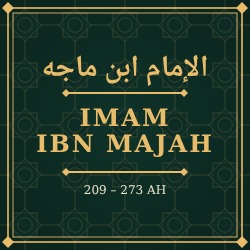
His full name was Abu 'Abdillah Muhammad ibn Yazid ibn Majah ar-Rab'i al-Qazwini. He was born in 209 AH (824 CE) in Qazwin, a city in northwestern Persia, in what is now Iran.
The name "Ibn Majah" often confuses readers. Majah was not his grandfather's given name in the usual sense. Most biographers say it was a title (laqab) of his father, Yazid. That is why the name is written Ibn Majah and not "Muhammad ibn Yazid ibn Majah" as a simple chain of fathers. You will also see it spelled Ibn Maajah, which is how the Dar-us-Salam biography renders it.
Qazwin was a garrison town at the time, close to the frontier with the Daylam region, and it had grown into a real center of learning by the third century. Ibn Majah studied first with the scholars of his own city before setting out to meet the masters of other lands.
The Journey for Knowledge
Like every great muhaddith of his generation, Ibn Majah did not wait for hadith to come to him. As a young man he began the rihlah, the journey in search of knowledge, and spent roughly fifteen years on the road.
His travels took him through:
- Khurasan and the cities of Rayy and Nishapur
- Iraq, including Baghdad, Basrah and Kufah
- The Hijaz, Makkah and Madinah
- Syria, especially Damascus and Hims
- Egypt
In each place he sat with the leading narrators, wrote down what they transmitted, and checked their chains against what he had heard elsewhere. That cross-checking was the core skill of a hadith critic, and it is what the biography presents as the "painstaking labor" behind his book.
His Teachers
Ibn Majah narrated from a long list of shaykhs. Among the best known are:
- Abu Bakr ibn Abi Shaybah, the Kufan hafiz and author of the Musannaf. A large share of the narrations in Sunan Ibn Majah come through him.
- Hisham ibn 'Ammar, the preacher and hadith master of Damascus
- Muhammad ibn Rumh of Egypt
- 'Ali ibn Muhammad at-Tanafisi
- Muhammad ibn Bashshar (Bundar) and Muhammad ibn al-Muthanna of Basrah, who were also teachers of al-Bukhari and Muslim
- Duhaym ('Abdur-Rahman ibn Ibrahim ad-Dimashqi)
Several of these were also the teachers of Imam al-Bukhari, Imam Muslim and Imam Abu Dawud as-Sijistani. The six compilers drew from the same well, which is one reason their books support and clarify one another.
His Students
Back in Qazwin, Ibn Majah taught for the rest of his life. His most important student was Abul-Hasan 'Ali ibn Ibrahim al-Qattan, through whom the Sunan was passed down to later generations. Others who narrated from him include Sulayman ibn Yazid al-Qazwini, Muhammad ibn 'Isa as-Saffar and Ibn Sibawayh.
What the Scholars Said About Him
The scholars who came after him spoke of Ibn Majah with clear respect:
- Abu Ya'la al-Khalili, the historian of Qazwin, described him as a trustworthy and major scholar, agreed upon, whose narrations are used as proof, and who had real knowledge and memorization.
- Adh-Dhahabi called him "al-Hafiz al-Kabir," a proof (hujjah) and a commentator on the Qur'an.
- Ibn Kathir wrote that his Sunan is evidence of his knowledge, his practice, his breadth of learning and his adherence to the Sunnah, in both the fundamentals and the details of the religion.
That last point matters. Sunan Ibn Majah opens with an introduction devoted to following the Sunnah of the Messenger of Allah ﷺ, honoring the Companions, and warning against innovation. Before a single ruling on prayer or trade, the reader is told where authority comes from.
His Writings
Ibn Majah wrote three works that we know of:
- As-Sunan, his collection of hadith, which survives and is the reason his name is known to every student of Islam.
- A Tafsir of the Qur'an, which Ibn Kathir praised as a full commentary. It has not survived.
- At-Tarikh, a work of history covering the Companions up to his own time. It too is lost.
Sunan Ibn Majah: What Makes It Different
A Sunan is a hadith collection arranged by topic, following the chapters of fiqh: purification, prayer, zakah, fasting, Hajj, marriage, trade, judgments and so on. Ibn Majah's book follows that pattern and contains 4,341 hadith in the standard numbering, spread across 37 books and roughly 1,500 chapters.
The Zawa'id: Hadith Found Nowhere Else
The defining feature of Sunan Ibn Majah is its zawa'id, the narrations it contains that do not appear in the other five books. Well over a thousand of its hadith fall into this category. Later scholars such as al-Busiri wrote whole works studying these additions one by one.
This is exactly what the Dar-us-Salam biography stresses: without Ibn Majah's work, a considerable body of narration would simply have been lost. His chapter headings are also very well organized, and he often covered topics the earlier compilers had treated more selectively, which makes the book easy to search for a specific ruling.
Is Sunan Ibn Majah Authentic?
This is one of the most common questions people ask, so it is worth being precise.
Sunan Ibn Majah is not a "Sahih" collection. Unlike Sahih al-Bukhari and Sahih Muslim, Ibn Majah did not limit himself to hadith that met the highest grade. The majority of the book is authentic (sahih) or good (hasan), but it also contains weak narrations, and a small number that scholars judged to be very weak or fabricated.
The great hadith critic Abu Zur'ah ar-Razi is reported to have praised the book highly when Ibn Majah showed it to him, though later scholars, adh-Dhahabi among them, noted that the weak material in it is more than that report suggests. Because of this, scholars rank Sunan Ibn Majah sixth among the six books, after the two Sahihs and the Sunans of Abu Dawud, an-Nasa'i and at-Tirmidhi.
The practical takeaway: Sunan Ibn Majah is an essential source, but each narration should be read alongside its grading. That is why a good edition matters. Dar-us-Salam's English translation gives a grade for every hadith, so the reader always knows where a narration stands.
How It Became One of the Six Books of Hadith
The phrase "six books of hadith" (Kutub al-Sittah, also called Sihah Sittah) did not always include Ibn Majah. For a long time the list was five, and scholars disagreed over the sixth:
- Some, such as Razin and Ibn al-Athir in Jami' al-Usul, named Imam Malik's Muwatta.
- Others preferred the Sunan of ad-Darimi.
- Ibn Tahir al-Maqdisi (d. 507 AH) was among the first to count Sunan Ibn Majah as the sixth, mainly because of its zawa'id. Most of the Muwatta's hadith already appear in the other five books, while Ibn Majah adds a great deal that is new.
Later scholars, including al-Mizzi in his work on the narrators of the six books, followed Ibn Tahir's choice, and it became the standard view.
His Death
Imam Ibn Majah died in Qazwin on a Monday, 22 Ramadan 273 AH (887 CE), at about 64 years of age. His brother Abu Bakr led the funeral prayer, and he was buried the next day. May Allah have mercy on him and reward him for what he preserved for this Ummah.
Lessons From the Life of Ibn Majah
- Knowledge is earned. Fifteen years of travel on foot and by caravan stand behind a book many of us can now hold in our hands.
- Preservation is a trust. Ibn Majah recorded what others had not, and that material reached us because of him.
- Honesty about sources. The scholarly tradition did not hide weak narrations. It graded them openly, and the work of grading Ibn Majah's book continues today.
- Method follows creed. He opened his book with the obligation to follow the Sunnah, a reminder that hadith study is an act of devotion and not only an academic field.
Read More About Imam Ibn Majah and His Sunan
The Biography
For the full story, including his upbringing, teachers, students, travels and methodology, get Imam Ibn Maajah from Dar-us-Salam's Biography of the Imams series. It is a short, readable volume that covers both his scholarship and his character.
Sunan Ibn Majah in English, Arabic and Urdu
- Sunan Ibn Majah (5 Vol. Set): the complete collection in Arabic with English translation, comments and a grading for every hadith.
- Arabic: Sunan Ibn Majah: the full Arabic text in one volume.
- Urdu: Sunan Ibn Majah (5 Vol. Set): the complete Urdu translation in five volumes.
The Other Five Books of Hadith in English
- Sahih Al-Bukhari (9 Vol. Set)
- Sahih Muslim (7 Vol. Set)
- Sunan Abu Dawud (5 Vol. Set)
- Sunan An-Nasa'i (6 Vol. Set)
- Jami' At-Tirmidhi (6 Vol. Set)
Prefer the Arabic? All six are bound together in Al-Kutub As-Sittah, a single-volume edition of the six books.
More From the Biography of the Imams Series
- Imam Abu Dawood As-Sijistani
- Imam At-Tirmidhi
- Imam Al-Bukhari
- Imam Muslim bin Al-Hajjaj
- Imam Ahmad bin Hanbal
- Shaykh Muhammad Nasiruddin Al-Albani, whose gradings of the Sunan are widely used today
Frequently Asked Questions
Who was Imam Ibn Majah?
Imam Ibn Majah (Abu 'Abdillah Muhammad ibn Yazid al-Qazwini, 209–273 AH) was a Persian hadith scholar from Qazwin and the compiler of Sunan Ibn Majah, one of the six canonical books of hadith.
Where was Ibn Majah born?
He was born in Qazwin, in northwestern Persia (present-day Iran), in 209 AH (824 CE).
How many hadith are in Sunan Ibn Majah?
Sunan Ibn Majah contains 4,341 hadith in the standard numbering, arranged in 37 books and about 1,500 chapters.
Is Sunan Ibn Majah authentic?
Most of its hadith are sahih or hasan, but it also includes weak narrations, so it is not classed as a Sahih collection. It is ranked sixth among the six books, and each hadith should be read with its grading.
Why is Sunan Ibn Majah one of the six books of hadith?
Mainly because of its zawa'id: well over a thousand narrations that are not found in the other five collections. Ibn Tahir al-Maqdisi counted it as the sixth book, and most later scholars followed him.
Is there an English translation of Sunan Ibn Majah?
Yes. Dar-us-Salam publishes Sunan Ibn Majah in a 5-volume set with the Arabic text, English translation, comments and a grade for every hadith.