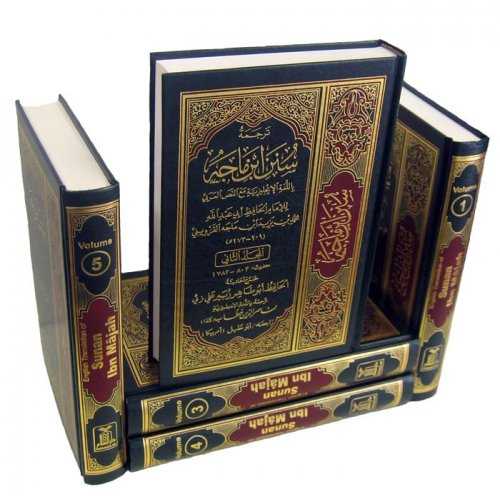
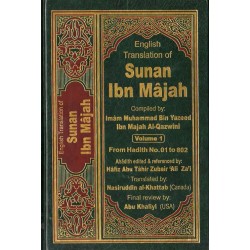
Sunan Ibn Majah complete in five volumes — one of the six most authentic collections, containing 4,341 Ahadith. Arabic with English translation and commentary.
About the Compiler
Imam Muhammad ibn Yazid Ibn Majah Al-Qazwini (rahimahullah, 209–273 AH) was born in Qazwin, in what is now northwestern Iran, a city that had grown into a center of Islamic learning in the generations before him. He began travelling in his teens, journeying through Iraq, the Hijaz, Syria and Egypt over some fifteen years to sit with the hadith scholars of each region before returning home to Qazwin, where he devoted the rest of his life to teaching, writing and narrating. Scholars who came after him, including Adh-Dhahabi, described him as reliable, knowledgeable and an authority relied upon in the field. His Sunan is counted as the sixth and last-compiled of the six canonical collections, and while it does not carry the same weight as the two Sahihs, it earned its place for the sheer amount of material it preserves that appears nowhere else — well over a thousand narrations found only in this one work.
What Sets It Apart
Imam Ibn Majah traveled across Khurasan, Iraq, the Hijaz, Egypt and Syria gathering narrations, and a considerable body of hadith reaches us through his work alone. Without it, that material would have been lost.
His scope is wide — theology, prayer, fasting, ethics and social conduct — and he covered subjects the earlier compilers had treated more selectively, which is part of why the collection earned its place among the six. As with any collection of this size, scholars have identified a small number of narrations within it as weak, so readers who want gradings hadith-by-hadith should look to the scholarly checks (such as those of Al-Albani) alongside the text.
The Dar-us-Salam Standard
As with the other translations of the six books of hadith, great care has been taken over accurate translation, clear modern English, and high-quality production.
Ahadith are followed by comments explaining the issues raised and helping readers derive the lessons — which is what separates a usable translation from a bare one. Additional features have been added to help readers get the most from the collection.
The Six Collections in English
Dar-us-Salam has translated all six canonical collections into English, to a consistent standard of translation, commentary and production:


 (5)
(5)