Fortress of the Muslim — Hisnul Muslim — is the standard collection of authentic supplications: the duas the Prophet ﷺ taught, arranged by occasion, each traced to the Qur'an or a sound hadith. Waking, sleeping, eating, traveling, entering and leaving, illness, distress, rain, fear, debt, the masjid, the market.
Built to Be Carried for Years
A pocket dua book leads a hard life. It goes in and out of a bag daily, travels in a suitcase, sits in a car through a Houston summer, and gets opened at the page for travel until that page gives up. Paperbacks lose their spine and their corners within a year or two of that treatment.
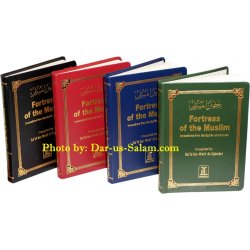
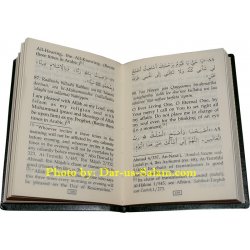
This edition is built for it: a semi-hardback cover that keeps its shape, and fine paper that is thinner and stronger than the regular stock, so a sturdier book comes out no larger — 3.8 x 4.8 inches, still a pocket size.
It is also the edition to buy when the book is a gift. A new Muslim, someone leaving for Hajj or Umrah, a graduation, a wedding, a child old enough for their own copy: a hardback in fine paper reads as something meant to last, which a paperback does not.
| Edition | Page Size | Binding | Paper | Best For |
|---|
| Large Print Paperback | 5.5 x 8 in | Paperback | Regular | Home, masjid, weak eyesight, teaching |
| Pocket Paperback | 3.35 x 4.6 in | Paperback | Regular | Pocket, bag, glovebox, giving away |
| Pocket Hardback (this item) | 3.8 x 4.8 in | Semi-hardback | Fine | Daily carry that has to survive, gifting |
All editions carry identical content. The differences are size, binding and paper. For teaching or weak eyesight take the large-print edition; for buying in quantity to give away, the pocket paperback costs less.
A Note from the Compiler
Shaykh Sa'id bin Ali bin Wahaf Al-Qahtani explains in his introduction that this book is an abridgement of his larger work, Adh-Dhikr wad-Du'a wal-'Ilaj bir-Ruqyah min al-Kitab was-Sunnah. To make it small and easily portable he selected only the section on words of remembrance, gave the text of each supplication rather than the full hadith, and limited himself to one or two references apiece. Readers wanting the narrator of a particular hadith or fuller sourcing should return to the original work.
He closes by asking Allah, by His beautiful Names and sublime attributes, to accept the effort as done sincerely for His sake, and to benefit its readers, its printers and everyone who has had a hand in distributing it.
Related Reading



 (6)
(6)