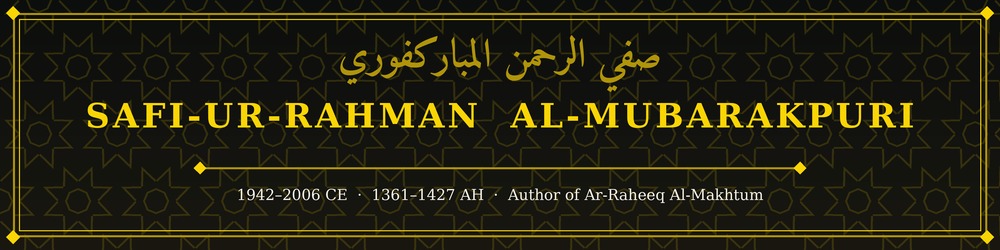
In 1976 the Muslim World League announced a worldwide competition for the best biography of the Prophet ﷺ. Manuscripts came in from across the Muslim world in Arabic, Urdu, English, French and Hausa. First prize went to a madrasah teacher from a weavers’ town in Uttar Pradesh who had never left India. Shaykh Safi-ur-Rahman al-Mubarakpuri (صفي الرحمن المباركفوري, Abu Hisham, 1942–2006 CE) wrote Ar-Raheeq Al-Makhtum — The Sealed Nectar — which is now, in English alone, among the most widely read books on the Prophet’s life ever published.
Name, Lineage and Birth
He is Safi-ur-Rahman ibn ‘Abdillah ibn Muhammad Akbar ibn Muhammad ‘Ali ibn ‘Abd al-Mu’min ibn Faqirullah al-Mubarakpuri al-A‘zami, and his kunyah was Abu Hisham.
He was born on 6 June 1942 in Husainabad, a village about a mile north of Mubarakpur in the district of Azamgarh, Uttar Pradesh — a town known for its handloom weaving rather than for anything else. His two nisbahs come from there: al-Mubarakpuri from the town, al-A‘zami from the district.
Mubarakpur has a longer scholarly history than its size suggests. It also produced ‘Abd ar-Rahman al-Mubarakpuri (d. 1935), author of Tuhfat al-Ahwadhi, the great commentary on Jami‘ at-Tirmidhi — and one of the teachers of Dr. Taqi-ud-Din al-Hilali, who travelled from Morocco to India to study hadith with him. The two Mubarakpuris were not related, but they came from the same small town, two generations apart.
Education
He began at home, reading the Qur’an with his grandfather and his uncle. He was then admitted to Madrasah ‘Arabiyyah Dar at-Ta‘lim in Mubarakpur for his foundational studies in Arabic and Persian.
- Shawwal 1373 AH (June 1954) — Madrasah Ihya’ al-‘Ulum, Mubarakpur, for Islamic studies and Arabic literature.
- Shawwal 1375 AH (May 1956) — Madrasah Faid-e-‘Aam, Mau Nath Bhanjan, Azamgarh, for higher studies.
- Sha‘ban 1380 AH — awarded the Fadilat degree after seven years of study, having also taken the government board’s Maulvi (1959) and ‘Alim (1960) certificates with high grades, and later passing the Fadil examinations in 1976 and 1978.
Twenty-Seven Years of Teaching
He began teaching, preaching and delivering sermons in 1961. His own account is candid that circumstances rarely let him settle: he moved from post to post for a decade before finding a permanent home.
- 1963 — teacher at Madrasah Faid-e-‘Aam, Mau Nath Bhanjan
- 1966 — Madrasah Dar al-Hadith in the same city
- 1969 — Principal of Madrasah Faid al-‘Ulum at Seoni, Madhya Pradesh
- 1972 — Principal of Madrasah ‘Arabiyyah Dar at-Ta‘lim, the school where he had himself begun
- Shawwal 1394 AH (October 1974) to 1988 — Jamiah Salafiyah, Banaras, the central Ahl-e-Hadith institution in India, where he taught across several departments and, from 1980, served as chief editor of its Urdu monthly Muhaddith
It was during these years — teaching full time in a provincial Indian madrasah, without the libraries of Cairo or Al-Madinah — that he wrote the book that made his name.
Ar-Raheeq Al-Makhtum
The Muslim World League convened the first Islamic Conference on the Seerah in 1976 and announced a worldwide contest for a book on the life of the Prophet ﷺ, with SR 150,000 in prizes for the best five entries.
171 manuscripts were submitted — 85 in Arabic, 64 in Urdu, 21 in English, one in French and one in Hausa — and judged by a board of scholars. The first prize, SR 50,000, went to the manuscript of Shaykh Safi-ur-Rahman al-Mubarakpuri of Jamiah Salafiyah, Banaras, cited for the authenticity and soundness of its narrations. The prizes were presented at a ceremony in Makkah on 12 Rabi‘ al-Awwal 1399 AH (1979 CE).
The title is taken from the Qur’an — the sealed nectar promised to the righteous:
“They will be given to drink of a pure sealed wine, whose seal is musk — and for that let the competitors compete.”
Surah Al-Mutaffifin 83:25–26
What won it the prize is also what keeps it in print: it is a narrated seerah. The Shaykh works from the sources, weighs the reports, and declines to embellish. It has since been translated into Arabic, Urdu, English, Bengali, Turkish, Indonesian, Hindi and more, and remains for most English-speaking Muslims the first complete life of the Prophet ﷺ they read.
Al-Madinah, Riyadh, and the Books You Already Own
Where our older page stops. The autobiographical note on our author page ends around 1990 with the words “where I am working as a Scholar to date.” That was accurate when he wrote it. What follows is what happened next.
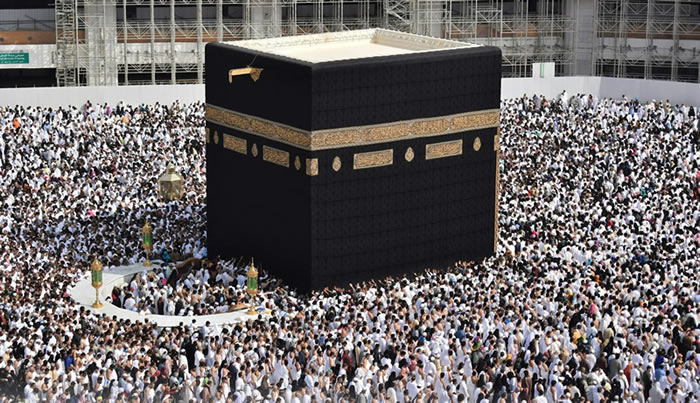
In 1408 AH (1988) he was selected for the newly founded Markaz Khidmat as-Sunnah was-Seerah an-Nabawiyyah at the Islamic University of Al-Madinah, charged with preparing an encyclopaedia of the Prophet’s life. He worked there until December 1997.
He then moved to Riyadh as a research scholar for Darussalam, at the invitation of Abdul Malik Mujahid — and this is where his name becomes attached to a large part of the catalogue on this website. In those years he supervised or produced:
- the Arabic abridgement of Tafsir Ibn Kathir, Al-Misbah al-Munir, and the ten-volume English Tafsir Ibn Kathir prepared under his supervision
- the selection and commentary for the Collection from Riyad-us-Saliheen
- Ithaf al-Kiram, his Urdu commentary on Bulugh al-Maram of Ibn Hajar
- When the Moon Split, his own abridgement of the seerah for younger and general readers, and histories of Makkah and Al-Madinah
He wrote and compiled around seventeen books in Urdu and Arabic, alongside a large body of essays on social, historical, political and religious subjects.
His Death
He returned to Husainabad — the village he was born in — and died there on Friday, 1 December 2006 (Dhul-Qa‘dah 1427 AH), after a long illness, at the age of sixty-four.
He was Salafi in creed and method, known for his defence of the Sunnah and his warning against innovation, and he required no caveat on any question of ‘aqidah.
A teacher in a weaving town in Azamgarh, writing in the hours around his classes, produced the book that introduced the Prophet ﷺ to more English-speaking Muslims than any other. That is ‘ilm nafi‘ — knowledge that continues to benefit — in the plainest sense the hadith intends.
“When a man dies, his deeds come to an end except for three: an ongoing charity, knowledge that is benefited from, or a righteous child who supplicates for him.”
Sahih Muslim 1631
May Allah have mercy on Shaykh Safi-ur-Rahman al-Mubarakpuri, accept his work, and gather him with the one whose life he spent his own describing.
Books by Shaykh Al-Mubarakpuri at Dar-us-Salam
- The Sealed Nectar — Ar-Raheeq Al-Makhtum
The prize-winning seerah in English, covering the Prophet’s lineage, the whole of his life in stages, and the spread of Islam. If a household owns one book on the Seerah, this is the one. Also stocked in other sizes and a full-colour edition. - Tafsir Ibn Kathir (10 Vol. Set)
The abridged English edition, prepared by a board of scholars under his supervision, with the unauthentic narrations removed. Around 6,600 pages. - Arabic: Al-Misbah al-Munir fi Tahdhib Tafsir Ibn Kathir
The Arabic abridgement of Ibn Kathir’s Tafsir that the English edition above is built on. - Collection from Riyad-us-Saliheen
His selection of the most important hadith from Imam An-Nawawi’s collection, with his commentary on each. Also available as a full-colour edition. - Urdu: Bulugh-ul-Maram (2 Vol. Set)
Ibn Hajar’s ahadith al-ahkam with Urdu translation and the Shaykh’s commentary.