To read the Arabic text of the Quranic verses in their correct form is of prime importance to every Muslim, as the meanings of the Arabic words change with small changes of the diacritics.
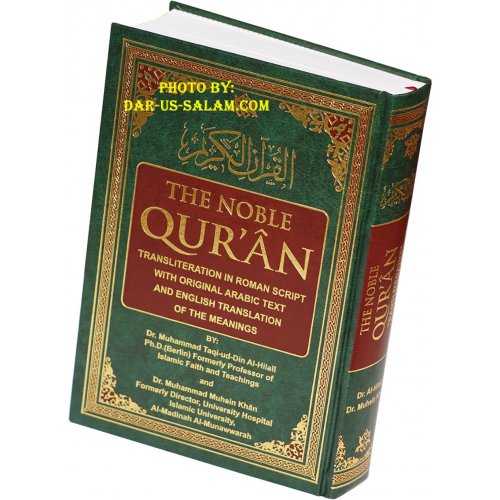
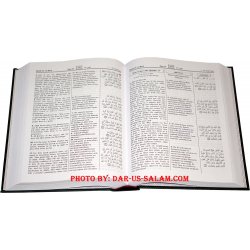
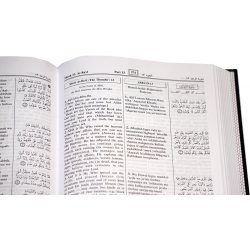
So, to help those readers and reciters who are not too familiar with the Arabic language or cannot read Arabic, Darussalam has prepared this edition of the Noble Quran, inserting the transliteration of the noble verses along with their translation.
What Transliteration Actually Solves
The waiting. A reader who cannot yet read the script has two options with an ordinary mushaf: recite nothing, or recite the English, which is not the Quran.
Transliteration removes the wait entirely. He recites the actual Arabic words today while learning the letters separately — and by the time he can read the script, he already knows how a great deal of it sounds.
A Word on Its Limits
Roman script cannot represent every Arabic sound precisely, and no transliteration system fully substitutes for learning to read. It is a bridge rather than a destination, and it works best alongside a teacher or a recitation to check against.
The Translation
Translated and compiled by Dr. Muhammad Muhsin Khan and Dr. Muhammad Taqi-ud-Din Al-Hilali — the rendering that has become the most widely distributed English translation of the Quran in the world, and the one used at the Haramain.
It follows the methodology of Ahlus Sunnah wal-Jama'ah and is based on authentic classical sources, with the commentary summarized from At-Tabari, Al-Qurtubi and Ibn Kathir, supported by relevant Ahadith from Sahih Al-Bukhari.
Who It Is For
New Muslims above all. Also converts' families, children, and anyone who learned Islam in English and has been putting off the script for years.
Related Reading


 (46)
(46)