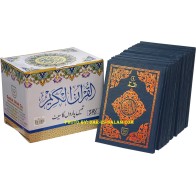
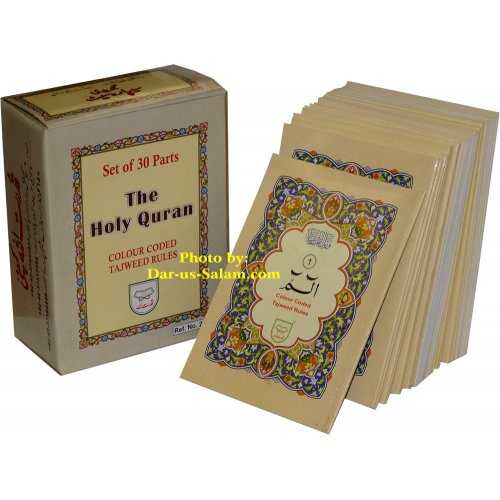
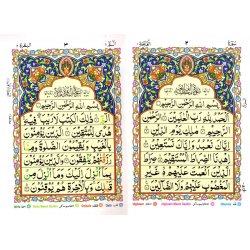
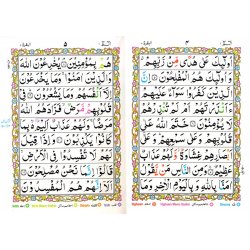
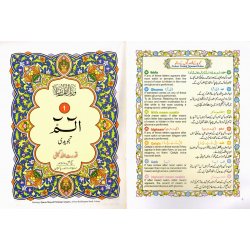
The complete Quran in 30 individually bound parts. This is the paperback set with color-coded tajweed, and the rules explained in both English and Urdu.
Why Buy the Quran in Thirty Pieces
Because a full mushaf is heavy, and that fact does more damage than people realize.
A child handed a thick, awkward book handles it carefully and reluctantly. A single juz weighs almost nothing, opens flat, and can be carried in one hand — and the difference in how willingly it gets picked up is considerable.
For memorization the argument is stronger still. A student working on one juz carries only that juz. He is not turning past twenty-nine others to find his place, and finishing a part means finishing an actual book, which is a real milestone rather than a bookmark moving.
The Other Common Use
Khatm al-Quran. Thirty separate parts allow thirty people to read the whole Quran at once — which is how a completion is organized for a bereavement, in Ramadan, or at a community gathering. A single mushaf cannot be divided; a sipara set is made for it.
Comparing the Sets
| Set | Lines | Format | Best for |
|---|
| View | 9 line | Paperback, 30 vols | Children, weak eyesight |
| View | 9 line | Hardback, 30 vols | Children, more durable |
| This edition | 9 line | Paperback, tajweed | Learning tajweed |
| View | 9 line | Hardback, tajweed | Tajweed, more durable |
| View | 13 line | Hardback, boxed | Portable, easy carrying |
| View | 6 line | Hardback, Urdu | Urdu translation per line |
Why the Line Count Matters
It is not a matter of taste. The line count decides where every page breaks, and a memorizer builds a visual map of where each passage sits — which line, how far down the page. That map only works if the layout stays constant.
Anyone who began memorizing from a particular line count should stay with it. Switching disrupts recall in a way that surprises people.
Related Items



 (13)
(13)