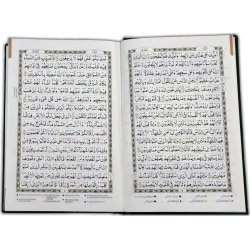
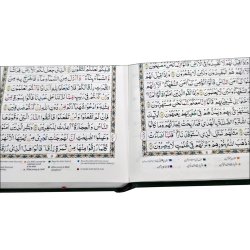
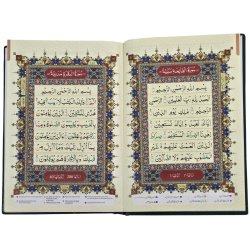
Color coding does something a written tajweed course cannot: it shows you the rule while you are reciting, at the exact moment it applies.
A student working from a textbook learns the rules and then has to spot them himself — which is where most people fail. Here the page tells him, and after enough repetitions he stops needing to be told.
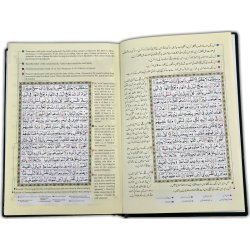
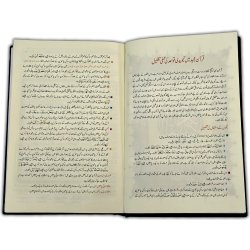
The key sits at the foot of every page, so nothing has to be memorized before starting, and the full pronunciation rules are set out in both Urdu and English at the end.
About the Indo-Pak Script
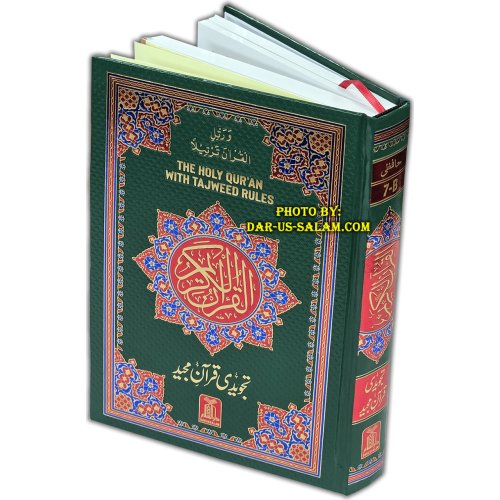
Also known as Persian or Pakistani script, these are the letterforms taught across Pakistan, India and Bangladesh. They differ noticeably from the Uthmani script used in Arab editions — in the shapes of certain letters and in how the vowel markings are placed.
A reader who learned one finds the other slower, particularly when reciting from memory. If you or your children learned to read the Quran in the subcontinent or in a madrasah following that tradition, this is the script to stay with.
Other 16 and 17-Line Editions in Persian / Indo-Pak Script
These share the same page layout as this edition — the Hafizi layouts, used by those memorizing the Quran. Because the pages break in the same places, a reader can move between them without disturbing his memorization.
Fewer lines means larger text, but the pages break differently — so anyone who has begun memorizing should stay with the line count he learned from. Also available in 11 line, 13 line and 15 line.


 (5)
(5)