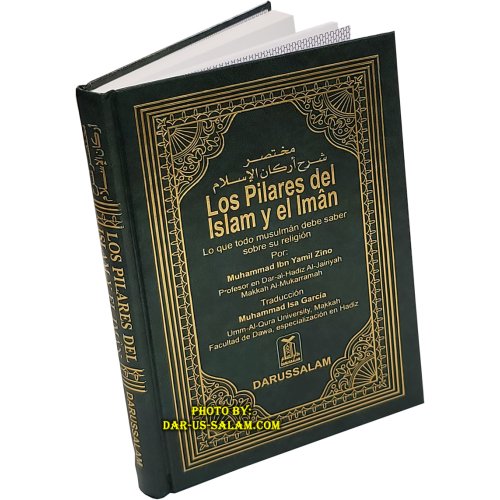
This is the Spanish translation of Pillars of Islam and Iman, which answers the question a new Muslim asks first and a lifelong Muslim is often embarrassed to ask: what exactly am I required to believe, and what exactly am I required to do? Shaykh Muhammad bin Jamil Zino answers it in 264 pages, without jargon and without assuming prior study.
The framework is the Hadith of Jibril, in which the Angel Jibril came to the Prophet ﷺ and asked him about Islam, Iman and Ihsan. That single narration organizes the whole of the religion, and the book follows it.
The Five Pillars of Islam and the Six Pillars of Iman
The first half covers the acts: the testimony of faith (Shahadah), establishing Salah, paying Zakah, fasting Ramadan, and performing Hajj. The second half covers the beliefs: Allah, His Angels, His revealed Books, His Messengers, the Last Day, and Al-Qadr. The link between the two halves is the point of the book: sound belief produces sound worship and sound character.
About the Author
Shaykh Muhammad bin Jamil Zino is originally from Syria and taught for many years at Dar-ul-Hadith Al-Khairiyah in Makkah Al-Mukarramah, valued for a plain style that stays anchored to authentic sources.
Resumen en Español
Esta es la traducción al español de Los Pilares del Islam y el Imán, del Shaykh Muhammad bin Jamil Zino, que responde en 264 páginas a la pregunta que todo nuevo musulmán se hace primero: ¿qué debo creer exactamente, y qué debo hacer exactamente? El libro sigue la estructura del célebre Hadiz de Jibril, en el que el ángel Gabriel preguntó al Profeta ﷺ sobre el Islam, el Imán y el Ihsan. La primera mitad explica los cinco pilares del Islam — el testimonio de fe, la oración, el ayuno, el zakat y el Hajj — y la segunda mitad explica los seis pilares de la fe: la creencia en Alá, Sus ángeles, Sus libros, Sus mensajeros, el Día del Juicio y el Decreto Divino. Cada punto se apoya en un versículo coránico o un hadiz auténtico, sin dar lugar a la costumbre heredada. Es uno de los primeros libros de Aqeedah recomendados a nuevos musulmanes y familias de habla hispana.