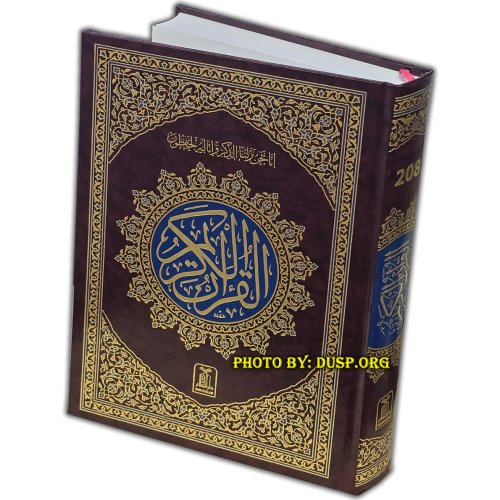
The 7 x 10 inch page gives the largest 15-line Indo-Pak text in the range — the size to choose for a household copy, for teaching, or for anyone whose eyesight is not what it was.
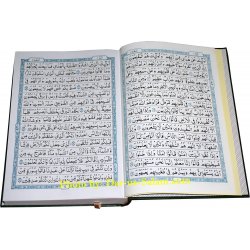
The two-color printing separates the text from the markings, which reduces visual effort noticeably over a long recitation.
Why "Each Page Ends at the Completion of an Ayah" Matters
It is a small phrase describing a real editorial decision, and it changes the reading experience considerably.
In most mushafs a verse can begin on one page and finish on the next. A reciter reaching the foot of a page mid-ayah has to turn while holding the sense of an unfinished sentence — and for anyone memorizing, that break falls in an awkward place.
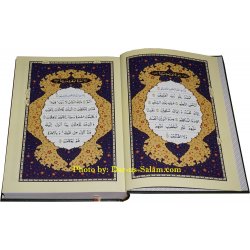
Here every page closes on a completed verse. You finish a thought, then turn.
Why the Line Count Matters
It is not a matter of taste. The line count decides where every page breaks, and a memorizer builds a visual map of where each passage sits — which line, how far down the page. That map only works if the layout stays constant.
Anyone who began memorizing from a particular line count should stay with it. Switching disrupts recall in a way that surprises people.
About the Indo-Pak Script
Also called Persian or Pakistani script, these are the letterforms taught across Pakistan, India and Bangladesh. They differ noticeably from the Uthmani script used in Arab editions, and a reader who learned one finds the other slower — particularly when reciting from memory.
If you or your children learned to read the Quran in the subcontinent, or in a madrasah following that tradition, this is the script to stay with.
Other 15-Line Editions in Persian / Indo-Pak Script
These share the same page layout as this edition — the most widely used layout, and the one most Indo-Pak readers learned from. Because the pages break in the same places, a reader can move between them without disturbing his memorization.
Fewer lines means larger text, but the pages break differently — so anyone who has begun memorizing should stay with the line count he learned from. Also available in 11 line, 13 line and 16 and 17 line.


 (10)
(10)