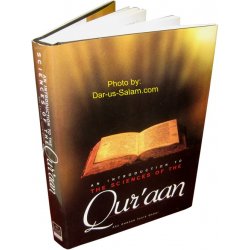
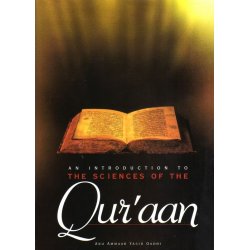
Sciences of the Qur'an (An Introduction to the Sciences of the Qur'an) by Dr. Yasir Qadhi is one of the most authoritative and comprehensive English-language works on 'Ulum al-Qur'an (علوم القرآن) available today. Written according to the methodology of Ahlus Sunnah wal-Jama'ah, this scholarly yet accessible reference introduces readers to the foundational sciences necessary for understanding the revelation, preservation, interpretation, and miraculous nature of the Noble Qur'an. Designed for students of knowledge, Islamic institutions, imams, and serious readers, this book bridges classical Islamic scholarship with contemporary academic presentation while remaining firmly rooted in authentic Islamic sources.
Covering over four hundred pages, the book systematically explains the historical and theological foundations of the Qur'an. Dr. Yasir Qadhi discusses the process of Wahy (Divine Revelation), the stages through which the Qur'an was revealed to Prophet Muhammad ﷺ, and the wisdom behind its gradual revelation. Readers gain a thorough understanding of the compilation and preservation of the Qur'an during the lifetimes of the Prophet ﷺ, Abu Bakr As-Siddiq, and Uthman ibn Affan (رضي الله عنهما), demonstrating the unmatched authenticity and preservation of Allah's final revelation.
The author carefully explores many of the core disciplines that form the sciences of the Qur'an, including the classifications of Makki and Madani verses, the occasions of revelation (Asbab al-Nuzul), the concept of Nasikh and Mansukh (abrogation), the seven Ahruf, the ten accepted Qira'at, the miraculous linguistic and rhetorical nature of the Qur'an (I'jaz al-Qur'an), and the principles governing authentic Tafsir. These discussions equip readers with the tools needed to approach the Qur'an correctly while avoiding common misunderstandings and misinterpretations.
One of the distinguishing features of this work is its balanced engagement with both classical Muslim scholarship and contemporary academic discussions. Dr. Qadhi introduces readers to the methodology of the great scholars of Tafsir while also examining modern Western and Orientalist studies concerning the Qur'an. He presents a thoughtful critique of common misconceptions regarding the compilation, authenticity, and transmission of the Qur'an, providing evidence-based responses grounded in traditional Sunni scholarship. The book also includes an informative history of English translations of the Qur'an together with an analytical review of several well-known translations, helping readers appreciate the strengths and limitations of each.
Despite addressing advanced academic topics, the book is written in a clear and engaging style that makes complex concepts understandable without sacrificing scholarly depth. It serves equally well as a university textbook, a reference for Islamic seminaries, a resource for study circles, and a valuable addition to every Muslim's personal library. Whether the reader seeks to understand how the Qur'an was preserved, how it should be interpreted, or why it remains the greatest miracle bestowed upon humanity, Sciences of the Qur'an provides a thorough and reliable foundation based upon authentic Islamic scholarship.
This landmark work remains one of the finest introductions to 'Ulum al-Qur'an in the English language. It strengthens faith by demonstrating the divine preservation, perfect transmission, miraculous eloquence, and timeless guidance of the Qur'an while encouraging readers to approach Allah's Book with greater knowledge, reverence, and understanding. It is an indispensable reference for students of Tafsir, teachers, da'wah workers, Islamic universities, and anyone seeking a deeper appreciation of the Noble Qur'an.
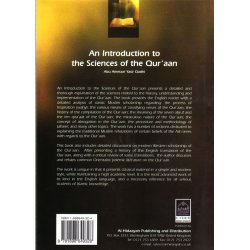
An Introduction to the Sciences of the Qur'aan presents a detailed and thorough explanation of the sciences related to the history, understanding, and implementation of the Qur'an. The book provides the English reader with a detailed analysis of classic Muslim scholarship regarding:
- Process of Inspiration (wahy)
- Various means of classifying verses of the Qur'an
- History of the compilation of the Qur'aan
- Meaning of the seven ahruf and the ten qira'aat of the Quran
- Miraculous nature of the Qur'aan
- Concept of abrogation in the Quran
- Procedure and methodology of tafseer
- and many other topics.
The work has a number of sections dedicated to explaining the traditional Muslim refutations of certain beliefs of the Ash'arees with regard to the Qur'aan.
This book also includes detailed discussions on modern Western scholarship of the Quran. After presenting a history of the English translation of the Qur'an, along with a critical review of some translations, the author discusses and refutes common Orientalist polemic literature on the Qur'an.
The work is unique in that it presents classical material in a simple and modern style, while maintaining a high academic level. It is the most advanced work of its kind in the English language and a necessary reference for all serious students of Islamic knowledge.
About the Author
Abu Ammaar Yasir Qadhi was born in Houston, Texas, but completed his primary and secondary education in Jeddah, Saudi Arabia. He graduated with a B.Sc. in Chemical Engineering from the University of Houston, after which he was accepted as a student at the Islamic University of Madinah. After completing a diploma in Arabic, he graduated with a B.A. from the College of Hadith and Islamic Sciences. He is presently doing an M.A. in Islamic Theology (Aqeedah) from the College of Da'wah at the University. His published works are: Riyaa: Hidden Shirk; An Introduction to the Sciences of the Qur'an; An Explanation of the Four Principles of Shirk; Du'a: The Weapon of the Believer; and others.



 (3)
(3) 