Turkish is spoken by more than eighty million people in Turkey, and by very large communities across Germany, the Netherlands, Austria, Belgium and beyond — among the biggest Muslim populations in Western Europe.
Why the Tafsir Matters
A plain translation tells a reader what a verse says. It does not tell him what a passage is responding to, why a ruling is phrased as it is, or how the scholars understood a difficult expression.
Including tafsir alongside the translation closes that gap on the page, at the moment the question arises — which is when a reader is actually willing to look something up.
The Arabic Alongside
The Arabic text is given with the translation, so the reader recites from the original and understands from the facing text. A translation carries the meaning of the Quran rather than replacing it, and an edition that keeps the Arabic present is the one that respects that distinction.
Who It Is For
Turkish-speaking readers at any level. It is particularly valuable for families in the European diaspora, where children may read German or Dutch more comfortably than Turkish while parents and grandparents read Turkish alone.
Related Reading
Türkçe Açıklama
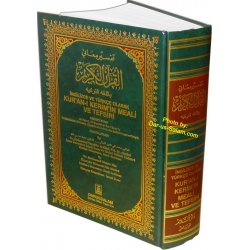
Kur'an-ı Kerim, Türkçe meali ve tefsiri ile birlikte, Arapça metin yanında.
Türkçe, Türkiye'de seksen milyondan fazla kişinin ana dilidir; ayrıca Almanya, Hollanda, Avusturya ve Belçika'daki büyük topluluklar tarafından da konuşulmaktadır — Batı Avrupa'nın en kalabalık Müslüman nüfusları arasında.
Yalın bir meal, ayetin ne dediğini söyler; ancak bir pasajın neye cevap verdiğini, bir hükmün neden o şekilde ifade edildiğini veya âlimlerin zor bir ifadeyi nasıl anladığını söylemez. Tefsirin mealle birlikte verilmesi, bu boşluğu tam da sorunun doğduğu anda kapatır.
Arapça metin meal ile birlikte verilmiştir: okuyucu aslından okur, karşı sayfadan anlar. Bir tercüme Kur'an'ın manasını taşır, onun yerini almaz — ve Arapçayı sayfada tutan bir baskı bu ayrımı gözetir.



 (1)
(1)