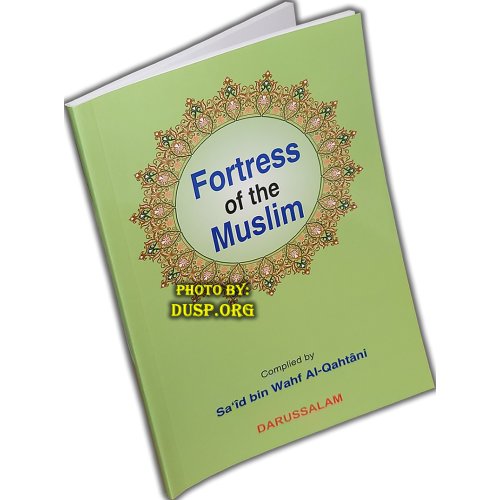
Fortress of the Muslim — Hisnul Muslim, sometimes translated as Citadel of the Believer — is the most widely used collection of authentic supplications in the Muslim world, and the book most often recommended to a Muslim who owns only one thing besides a mushaf.
It gathers the duas the Prophet ﷺ taught, arranged by occasion, each traced to the Qur'an or an authentic hadith. Waking and sleeping. Leaving the house and entering it. Before and after eating. Travel. Rain, wind, illness, fear, debt and distress. Entering the masjid, entering the market, seeing something that pleases you and something that alarms you. Very little of an ordinary day is left uncovered.
Why the Large Print Matters
This edition carries exactly the same supplications as the pocket versions, set in a larger size on a bigger page. The people who need that are easy to identify and often poorly served: older readers, anyone using reading glasses, and anyone reciting the Arabic rather than only the translation — Arabic loses its diacritics to small type faster than English loses legibility.
It is also the edition to buy for teaching. A parent working through the morning adhkar with a child, or a teacher with a class, needs a page two people can look at.
| Edition | Page Size | Binding | Paper | Best For |
|---|
| Large Print Paperback (this item) | 5.5 x 8 in | Paperback | Regular | Home, masjid, weak eyesight, teaching |
| Pocket Paperback | 3.35 x 4.6 in | Paperback | Regular | Pocket, bag, glovebox, giving away |
| Pocket Hardback | 3.8 x 4.8 in | Semi-hardback | Fine | Daily carry that has to survive, gifting |
All editions carry identical content. The differences are size, binding and paper.
A Note from the Compiler
Shaykh Sa'id bin Ali bin Wahaf Al-Qahtani explains in his introduction that this book is an abridgement of his larger work, Adh-Dhikr wad-Du'a wal-'Ilaj bir-Ruqyah min al-Kitab was-Sunnah. To make it small and easily portable he selected only the section on words of remembrance, gave the text of each supplication rather than the full hadith, and limited himself to one or two references apiece. Readers wanting the narrator of a particular hadith or fuller sourcing should return to the original work.
He closes by asking Allah, by His beautiful Names and sublime attributes, to accept the effort as done sincerely for His sake, and to benefit its readers, its printers and everyone who has had a hand in distributing it.
Related Reading



 (5)
(5)