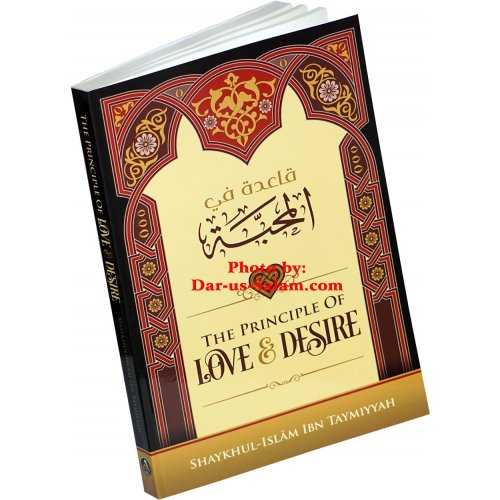
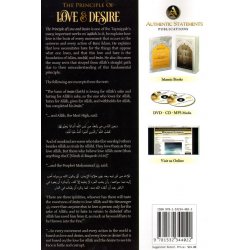
The Principle of Love and Desire is one of Ibn Taymiyyah's many important works on 'aqidah. In it, he explains how love is the basis of every movement that occurs in the universe and every action of Bani Adam. He explains that love necessitates hate for the things that oppose what one loves, and that this love and hate is the foundation of Islam, Tawheed and Iman. He also discusses the many sects that strayed from Allah's straight path due to their misunderstanding of this fundamental principle.
Excerpts From the Text
"The basis of iman (faith) is loving for Allah's sake and hating for Allah's sake, so the one who loves for Allah, hates for Allah, gives for Allah, and withholds for Allah, has completed his iman."
Ibn Taymiyyah continues, citing Allah's statement:
"And of mankind are some who take (for worship) others besides Allah as rivals (to Allah). They love them as they love Allah. But those who believe love Allah more (than anything else)." [Surah Al-Baqarah 2:165]
And the words of the Prophet Muhammad ﷺ:
"There are three qualities, whoever has them will taste the sweetness of iman: to love Allah and His Messenger ﷺ more than anyone else; to love a person only for the sake of Allah; and to hate to return to disbelief after Allah has saved him from it, as much as he would hate to be thrown into the Fire."
"So every movement and every action in the world is based on love and desire, and every love or desire that is not based on the love for Allah and the desire to see His Face is futile and corrupt."
Why This Book Matters
Because it dismantles the assumption that action follows mere intellectual assent. Ibn Taymiyyah argues that a person acts, ultimately, toward what he loves and away from what he hates — which means the state of a person's heart, not only the content of his beliefs, determines his conduct.
Who It Is For
Students of creed working through Ibn Taymiyyah's major treatises, and any reader interested in the psychological and spiritual dimension of Tawheed rather than only its propositional content.
Related Reading


 (3)
(3)