"We will show them Our signs in the universe and within themselves, until it becomes clear to them that it is the truth." (Surah Fussilat 41:53)
That verse is the reason this book exists. It promises that creation itself argues for its Creator — and it places the evidence in two locations, the world outside a person and the person himself.
Where the Material Comes From
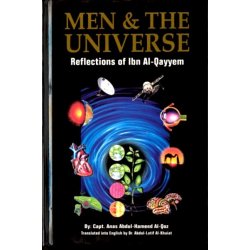
The text is drawn from Ibn Al-Qayyim's Miftah Dar As-Sa'adah (Key to the Abode of Happiness). This section was extracted because it treats the signs of Allah in human beings and in the universe, and because of the perceptive and meaningful wisdom Ibn Al-Qayyim brings to it.
What distinguishes his handling is that he does not simply present conclusions. He calls for the use of the intellect and for self-examination — he teaches the technique of reflection, and sets out how a person should go about contemplating creation so that the exercise actually yields something.
Four Parts
- Man — the construction of the human being, and what it implies
- The universe — the order of the wider creation
- Animals — their forms, instincts and provision
- Nature — natural phenomena and the sustaining behind them
Much of it concerns the biology of humans and animals, with sustained reflection on how meticulous the design is and how watchful the provision that keeps it running.
The Compiler's Addition
Capt. Anas Abdul-Hameed Al-Qoz supports Ibn Al-Qayyim's text with accounts of modern scientific discoveries, useful notes, figures, tables and pictures. The effect is a book that reads across seven centuries at once — a fourteenth-century scholar's observation of a natural phenomenon set beside what is now known about it, both pointing the same direction.
Who It Is For
Readers who find their faith stirred more by creation than by argument. Students and teachers of science looking for a serious Islamic engagement with the natural world. Families and older children — the illustrated format carries well. Da'wah workers speaking with people who respect evidence and are unmoved by exhortation.
Related Reading



 (3)
(3)