
| Subtitle | آدم - بين التطور والوحي |
| Author | Ibrahim Elshahat |
| Binding | Paperback |
| Pages | 217 |
| Size in Inches | 6x9x0.80 |
| Size in CM | 15.5x23x1.40 |
| Edition | 1st (2022) |
| Format | 2-Color Text |
| Weight (lbs) | 0.86 |

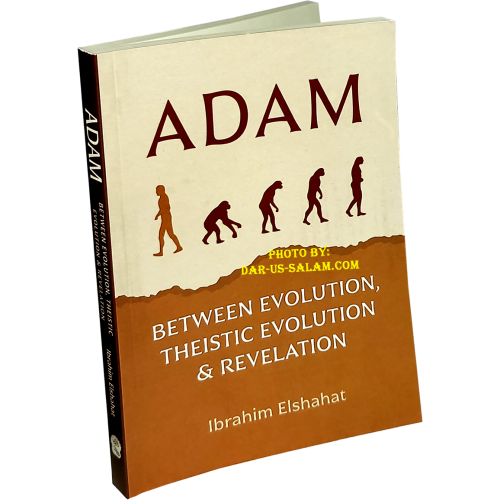
Adam Between Evolution & Revelation by Ibrahim Elshahat is a thoughtful, scholarly treatise spanning 217 pages, which examines the origin of humanity through the lenses of scientific theory and Islamic revelation. The book engages critically with the modern debates surrounding human evolution and the concept of creation, offering a comparative study of evolutionary theories (including both strict Darwinian evolution and theistic evolution) and the Qur’anic–Sunnah narrative concerning the story of Adam (ʿalayhi al-salām).
Elshahat does not dismiss science altogether — rather, he analyzes the strengths and limitations of evolutionary arguments: genetics, fossil records, common ancestry claims — but highlights where empirical science falls short of offering certainty about human origins, especially regarding consciousness, meaning, and purpose. He argues that many evolutionary interpretations are philosophical assumptions rather than proven facts, and that when it comes to ultimate origins, revelation (the Qur’an and Sunnah) holds epistemic priority over speculative theories.
Through careful textual analysis, the author demonstrates that the Qur’an presents Adam not merely as a symbolic figure or metaphor, but as the first human being specially created by Allah — a being whose creation from clay and whose special status over other creation is affirmed in verses such as:
«لَقَدْ خَلَقْنَا الْإِنسَانَ فِي أَحْسَنِ تَقْوِيمٍ» — (We have created man in the best stature)
The book also addresses philosophical dilemmas often used to challenge revelation — such as the problem of evil, suffering, and the existence of meaning — showing that these problems remain unsolved under purely naturalistic frameworks, whereas Islam offers coherent explanations linked to purpose, accountability, and an afterlife.
What makes this work distinct is its balanced style: it avoids polemical rhetoric, instead favoring respect, clarity, and reasoned argumentation. This makes the book suitable for Muslims seeking clarity, new converts (reverts, Muslims grappling with doubts, students of dawah, and anyone interested in the intersection between science, philosophy, and Islamic theology. As such, Adam Between Evolution & Revelation serves as a bridge — allowing believers to approach scientific discourse without compromising their Tawḥīd or faith in the Sunnah.
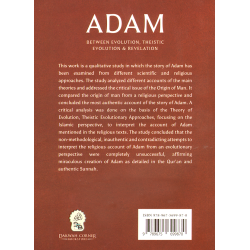
This work is a qualitative study in which the story of Adam has been examined from different scientific and religious approaches. The study analyzed different accounts of the main theories and addressed the critical issue of the Origin of Man. It compared the origin of man from a religious perspective and concluded with the most authentic account of the story of Adam. A critical analysis was done on the basis of the Theory of Evolution, Theistic Evolutionary Approaches, focusing on the Islamic perspective, to interpret the account of Adam mentioned in the religious texts. The study concluded that the non-methodological, inauthentic, and contradicting attempts to interpret the religious account of Adam from an evolutionary perspective was completely unsuccessful, affirming the miraculous creation of Adam as detailed in the Qur’an and authentic Sunnah.