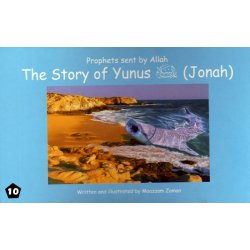
Yunus عليه السلام grew tired of a people who would not listen, and left before he had been given leave to.
What followed is the part every child knows: the ship, the storm, the lot drawn, the sea, and the whale.
The Part Worth Teaching
What he said inside it. In darkness upon darkness he called out that there is no god but Allah, that He is far above any imperfection, and that he himself had been among the wrongdoers.
He did not argue that he had been provoked, which he had. He said plainly that he was wrong.
Allah answered him, and the Qur'an adds that He saves the believers in the same way — which is why this supplication is one of the first a Muslim is taught to reach for in distress.
Told in rhyme, with the whale on the page where a child expects it and the lesson underneath where it belongs.
How the Series Works
Simple full-color illustrations accompany rhyming poetry that is fun to read aloud and surprisingly easy to remember — which is the point. A child who has heard a story in verse a dozen times can recite parts of it back, and what he can recite he retains.
Each book carries an "Islamictionary": a simplified children's glossary explaining the Arabic and Islamic words as they appear. That single feature is why the books work in non-Arabic-speaking households, where a parent reading aloud otherwise has to stop and improvise a definition.
Hard, durable full-color pages with the picture on the left and the text on the right. Each book is 8 x 5 inches and three-quarters of an inch thick — built for the handling a favorite book gets.
The Rest of the Series
Fifteen titles, each on one Prophet, all in the same rhyming format:
The boxed set brings them together at a discount.



 (1)
(1)