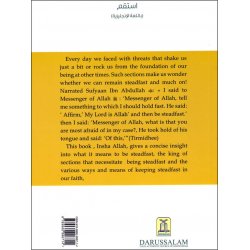
Every day brings something that shakes us a little, and occasionally something that rocks us from the foundation of our being. In those moments a person wonders whether he can hold firm at all.
The Hadith Behind the Book
Sufyan ibn Abdullah رضي الله عنه said:
"I said to the Messenger of Allah ﷺ: Messenger of Allah, tell me something to which I should hold fast. He said: Say, 'My Lord is Allah,' and then be steadfast. Then I said: Messenger of Allah, what is it that you most fear for me? He took hold of his tongue and said: This." (At-Tirmidhi)
Both halves of that exchange matter. The instruction is simple enough to remember under pressure. And the answer to the second question is not what anyone expects — the greatest danger to a man's steadfastness is not persecution or hardship but his own tongue.
What the Book Gives
A concise insight into three things: what it actually means to be steadfast; the kinds of situation that require it; and the various ways and means of keeping firm in faith.
That third part is the practical one. Steadfastness is not a temperament some people happen to have. It is maintained by specific means — company, knowledge, worship, remembrance, and guarding the tongue that the Prophet ﷺ singled out.
Who It Is For
Anyone going through something that is testing his faith. New Muslims, for whom the first years bring pressures nobody warned them about. Young people. Muslims living where practicing the religion costs something socially. Short enough to read in a sitting, and better kept for rereading.
Related Reading