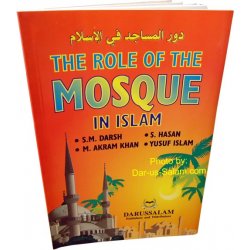
Count the buildings you enter regularly. For a practicing Muslim the list is short: home, work, and the masjid — visited at least twice a day and often five times. No other institution in Islam has that kind of standing in an ordinary week, and this booklet explains why.
More Than a Prayer Hall
The mosque is where a Muslim renews his connection with his Creator, where his spirituality is rekindled at intervals short enough that it does not have time to fade. It is also where he meets other Muslims face to face and recovers his sense of belonging to something larger than his household — which is precisely what is lost when prayer becomes a private activity performed alone at home.
What the Prophet's Masjid Actually Was
The first thing the Prophet ﷺ built on arriving in Madinah was the masjid, and it was never only a place of prayer. It was where the Qur'an was taught, where disputes were settled, where delegations were received, where the community was addressed and where those with nowhere else to go were sheltered. The prayer hall, the school, the court and the assembly were one building.
Much of that has been separated out over the centuries, and the booklet asks what was lost in the separation — and how much of it a mosque today could recover.
Who It Is For
Masjid committees and boards thinking about what their building is for beyond the five prayers. Imams and community workers. Muslims who pray at home out of habit and have stopped noticing what they are missing. Non-Muslims who want to understand what the building on their street actually is. Short, inexpensive, and easy to distribute in quantity.
Related Reading



 (1)
(1)