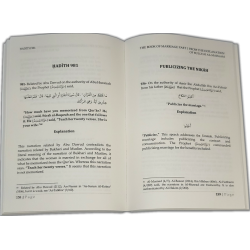
Abu Hurayrah (may Allah be pleased with him) reported that the Prophet ﷺ said:
"A woman is married for four reasons: for her wealth, for her class, for her beauty, or her piety. Select the pious, may your hand be rubbed in the dust!"
In this hadith is a reference that men's most desirable marriage purposes revolve around these four: wealth, class, beauty and piety.
The Benefits Drawn From This Hadith
There is no problem if anyone marries a woman for her wealth, because the Prophet ﷺ approves this — but he urges marrying the religious woman. There is no problem if a man marries a woman for her class, to elevate himself and his children. A woman may be married for her beauty, and there is no problem in that; a man may value beauty and find he cannot be content otherwise, as men differ greatly in this respect.
And a woman may be married for her piety, even if this is the only purpose. The best of these purposes is to marry a woman for her piety, as he ﷺ said: "Select the pious, may your hand be rubbed in the dust."
Why the Hadith Permits Before It Prefers
The Prophet ﷺ did not forbid the first three motives — he acknowledged them as the ordinary reasons people marry, and then directed toward the one that lasts. Wealth can go. Class means nothing in a difficult marriage. Beauty changes. Piety is the only one of the four that tends to increase rather than diminish over a lifetime together.
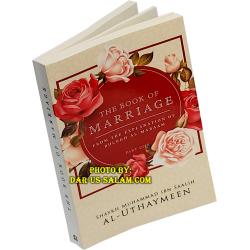
Key Features and Themes of the Book
- Comprehensive commentary — a thorough explanation of the hadiths compiled in the chapters of marriage in Bulugh al-Maram, clarifying the meaning and implication of each
- Islamic legal rulings — the requirements for a valid marriage contract, the rights and responsibilities of spouses, and the conditions for permissible marriage
- Practical guidance — on choosing a spouse, conducting the marriage ceremony, and maintaining a harmonious relationship
- Qur'anic references — explanations supported throughout by relevant verses
- Addressing contemporary issues — challenges faced by Muslim couples today, with solutions based on the principles of the Shari'ah
- Educational resource — suited to study circles, Islamic schools and personal study
- Authenticity and scholarship — explanations based on authentic sources and traditional Islamic scholarship
- Focus on morality and ethics — emphasizing the spiritual and moral dimensions of marriage, not only its rulings
Who It Is For
Students of fiqh working through Bulugh al-Maram, imams counseling couples, and anyone wanting a scholarly, hadith-grounded treatment of marriage rather than a purely practical guide. It combines scholarly rigor with practical advice, making it a valuable addition to any Islamic library.
The Three Parts
| Part | Covers |
|---|
| This volume (Part 1) | Choosing a spouse, the marriage contract, the walimah |
| Part 2 | Compatibility, the rights and duties of spouses |
| Part 3 | 'Ali's marriage to Fatimah, further rulings on married life |
Related Reading



 (4)
(4)