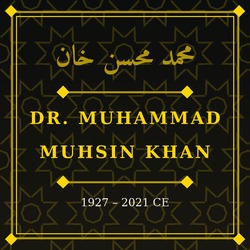

He was a chest physician, not a scholar. Dr. Muhammad Muhsin Khan (محمد محسن خان, 1927–2021 CE) trained in medicine in Lahore and in Wales, spent his working life running tuberculosis wards in Ta’if and Al-Madinah — and became the first person ever to translate the complete Sahih al-Bukhari into English. With Dr. Muhammad Taqi-ud-Din al-Hilali he also produced the Noble Qur’an, the translation most English-speaking Muslims have read. If you own an English Bukhari, it is almost certainly his.
Origins and Training
He is Muhammad Muhsin, son of Muhyi-ud-Din, son of Ahmad al-‘Isa al-Khoashki al-Jamandi al-Afghani. His family belonged to the Afghan tribe of Khoashki Jamandi, settled in a valley south-east of Kandahar. His grandfathers left Afghanistan to escape tribal warfare and settled in British India.
He was born in 1345 AH (1927 CE) in Kasur, a city in the Punjab, in what is now Pakistan. He was educated there, then took his degree in Medicine and Surgery from the University of the Punjab, Lahore, and worked at the University Hospital in the city. He travelled to England, staying about four years, and earned the Diploma in Chest Diseases from the University of Wales — at a time when very few from his background studied in the West at all.
He then joined the Ministry of Health of the newly established Kingdom of Saudi Arabia, arriving in the reign of King ‘Abd al-‘Aziz Al Sa‘ud, and served there for around fifteen years. Most of that time was in Ta’if, as director of the hospital for chest diseases. He then moved to Al-Madinah as Chief of the Department of Chest Diseases at the King’s Hospital, and finally as Director of the University Clinic at the Islamic University of Al-Madinah.
A Dream, and Twenty Years of Work
The turn from medicine to translation has a specific cause, and he told it himself in the introduction to The Noble Qur’an.
In Al-Madinah he saw the Prophet ﷺ in a dream, amid a large gathering. He moved to kiss his knees out of love and was not permitted to; then he drank of the perspiration flowing from him; then the Prophet ﷺ asked him for a sheet of paper, wrote on it that he wanted him, and sealed it. He woke overwhelmed and asked the people of knowledge what it meant. He was told it meant he would serve the Prophet’s sayings. Dr. Yasir Qadhi relates that the shaykh he asked was ‘Abd al-‘Aziz ibn Baz, may Allah have mercy on him, then Rector of the Islamic University, and that Dr. Muhsin’s reaction was plain bewilderment — he was no scholar, and his training was in medicine.
He went looking for a project anyway. He settled on the most demanding one available: the Sahih of al-Bukhari, untranslated into English in full, and set about it in the hours left over from running a hospital department. The nine volumes took him the better part of two decades.
“The best of people are those most beneficial to people.”
Reported by at-Tabarani and others; graded hasan by al-Albani in Sahih al-Jami‘ 3289.
His Translations
A point worth getting right. Our older author page describes Sahih al-Bukhari, Al-Lu’lu’ wal-Marjan and the Qur’an all as joint works with Dr. al-Hilali. In fact the division is: the Noble Qur’an was the joint translation by al-Hilali and Muhsin Khan, while Sahih al-Bukhari and Al-Lu’lu’ wal-Marjan were Dr. Muhsin Khan’s own. Every obituary of him leads with the same phrase — the first person to translate Sahih al-Bukhari into English — and that credit belongs to him alone. The page also renders the title as “Al-lu’lu’ wal Margan”; it is Al-Lu’lu’ wal-Marjan, and the misspelling currently sits in the page’s meta description as well.
| Work | Note |
|---|---|
| The Translation of the Meanings of Sahih Al-Bukhari | Nine volumes, Arabic with English. The first complete English rendering of the collection, and still the standard one. His own work. |
| The Noble Qur’an | With Dr. Muhammad Taqi-ud-Din al-Hilali. Published in a detailed nine-volume form with commentary drawn from at-Tabari, al-Qurtubi and Ibn Kathir plus ahadith from the Sahihayn, and in a summarised single volume. Distributed worldwide in the millions. |
| Al-Lu’lu’ wal-Marjan | “Pearls and Corals” — Muhammad Fu’ad ‘Abd al-Baqi’s compilation of the narrations agreed upon by al-Bukhari and Muslim, in English translation. |
| Summarized Sahih Al-Bukhari | 2,220 hadith condensed into a single volume from the nine — the entry point for most readers. |
His Death
He died on the morning of Wednesday, 14 July 2021, in Al-Madinah. His funeral prayer was performed in Masjid an-Nabawi after Fajr the following day, and he was buried in Jannat al-Baqi‘.
On his age. The obituaries say ninety-seven; the calendar says he was born in 1927 and died in 2021, which is ninety-four. Both are right. He was ninety-seven Hijri years old — 1345 to 1442 AH — and about ninety-four solar years. Lunar years run roughly eleven days shorter, and across a long life the gap compounds.
A man who was told, in effect, that he would serve the Sunnah, and who had no scholarly training with which to do it, buried beside the Prophet’s mosque having put the two most authentic books in Islam into the language of half the world. Our own author page still speaks of him in the present tense; it is time that was corrected, and that we made du‘a for him.
May Allah have mercy on Dr. Muhammad Muhsin Khan, accept this work from him, and reward him on behalf of every English-speaking Muslim who has read the Sunnah because of it.
Translated by Dr. Muhsin Khan at Dar-us-Salam
- Sahih Al-Bukhari (9 Vol. Set)
The unabridged Arabic-English edition, around 4,000 pages. His life’s work, and the reason English-speaking Muslims can read al-Bukhari at all. - The Noble Qur’an, Arabic/English (9 Vol. Set with Full Tafsir)
With Dr. al-Hilali. Arabic text from the Mushaf al-Madinah, with commentary summarised from at-Tabari, al-Qurtubi and Ibn Kathir, and the relevant ahadith in full. Also available in a summarised single volume. - Summarized Sahih Al-Bukhari
2,220 hadith in one volume of about 1,000 pages. The practical way in for a first-time reader. - Al-Lu’lu’ wal-Marjan — Pearls & Corals (2 Vol. Set)
Only the narrations that both al-Bukhari and Muslim recorded — the most rigorously established material in the Sunnah, in plain English.