القرآن الكريم المجود برواية ورش عن نافع
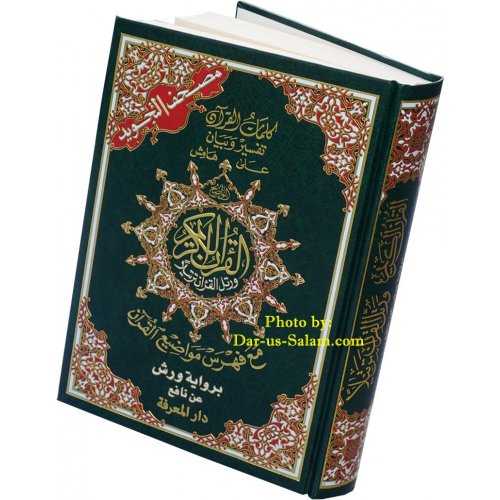
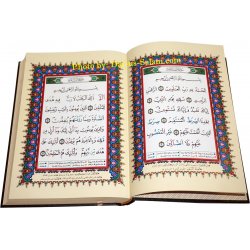
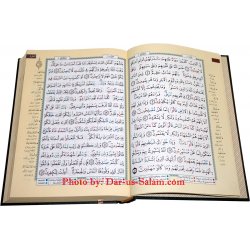
This large deluxe hardback edition of the color-coded Tajweed Qur'an is in the Warsh narration. Unlike the standard Hafs 'an 'Asim qiraah found in most printed mushafs, this reading is used mostly by people from bilaad al-Maghrib — Morocco, Algeria, Tunisia, Mauritania and much of West Africa. Interpretation of selected words is placed on the margin of each page.
What a Different Narration Actually Means
The Qur'an was revealed in several authentic modes of recitation, all traced back to the Prophet ﷺ through unbroken chains. They differ in small points of pronunciation, in the lengthening of certain vowels, and occasionally in the vocalization of a word — never in meaning or message.
Warsh transmitted his reading from Imam Nafi' al-Madani of Madinah, and it became the dominant recitation across the western Muslim world. A reader raised in Casablanca or Dakar learned Warsh; a reader raised in Cairo or Karachi learned Hafs.
Who Should Buy This Edition
Anyone who learned to recite in the Maghrib or West Africa, and who has been making do with a Hafs mushaf ever since. The difference is noticeable enough to disrupt recitation and memorization alike.
It is also of real value to students of qira'at, and to imams serving congregations from those regions.
If you learned from a standard mushaf, this is not the edition to buy. Choose the Hafs Tajweed Qur'an instead — switching narration mid-way through memorization causes considerable difficulty.
Why Recite From a Tajweed Qur'an
Tajweed is not an optional refinement — it is the manner in which the Qur'an was revealed and the manner in which the Prophet ﷺ recited it. Yet most students learn the rules in a classroom and then lose them the moment they open a plain mushaf, because nothing on the page reminds them where a madd stretches, where a letter is nasalized, or where a qalqalah echoes.
Errors settle into muscle memory and become progressively harder to correct. A color-coded mushaf closes that gap: the rule is printed into the word itself, so it is applied at the moment of reciting rather than recalled afterward.
The Color-Coded Tajweed System
Dar Al Maarifah's editors grouped the letters phonologically and gave each group its own printed color:
- Red — letters requiring extended vocalization (madd)
- Green — nasalized letters (ghunnah, ikhfa, idgham)
- Dark blue — the emphatic ر (raa')
- Light blue — qalqalah, the echoing letters
- Gray — letters written but left unpronounced
Twenty-four tajweed rules are applied this way, leaving the reader's attention free for the meaning of the verse rather than the mechanics of the recitation.
Every Tajweed Qur'an in This Range Includes
- Color-coded letters presenting the rules of tajweed visually
- Uthmani script following the Madinah standard
- Interpretation of selected words on the page margins
- High-quality printing on fine paper
Note: the cover color may differ depending on current stock.
Other Narrations (Qira'at)
The Qur'an was revealed in several authentic modes of recitation. Nearly every mushaf in print uses Hafs 'an 'Asim, which is what most Muslims worldwide recite; the editions below carry the other narrations, printed with the same color-coded tajweed system.


 (3)
(3)