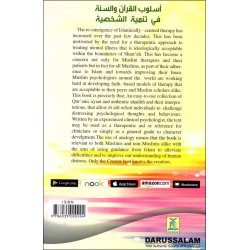
Islamically centered therapy has re-emerged over the past few decades, driven by a real need: a therapeutic approach to mental illness that is ideologically acceptable within the boundaries of the Shari'ah.
That need is not only a clinical one. It concerns Muslim therapists and their patients, and it concerns all Muslims — as part of adherence to Islam and of improving one's Iman.
What This Book Is
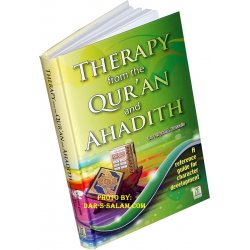
Muslim psychologists worldwide are working to develop faith-based models of therapy acceptable to their professional peers and to Muslim scholars alike. This book is precisely that, in its most usable form: a collection of verses and authentic narrations, with their interpretations, arranged so that a person can use them to challenge distressing thoughts and behaviors.
It was written by an experienced clinical psychologist, which shows in the structure. The material is organized by the difficulty being addressed rather than by chapter of the Qur'an, so it can be reached for at the point of need.
Three Ways It Is Used
- As a therapeutic aid alongside treatment
- As a reference for clinicians working with Muslim clients
- As a general guide to character development, with no clinical context at all
Its Reach Beyond Muslims
The use of analogy makes the book relevant to Muslims and non-Muslims alike — the aim being to draw on guidance from Islam to relieve difficulty and improve our understanding of human distress. As the author puts it: only the Creator best knows the creation.
A Word on Scope
This is a companion to proper care, not a replacement for it. Anyone experiencing serious or persistent psychological difficulty should be under the care of a qualified professional, and the book is written by someone who would say the same.
Related Reading



 (2)
(2)