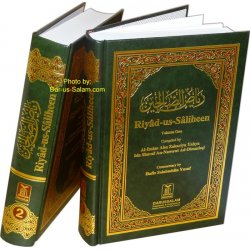
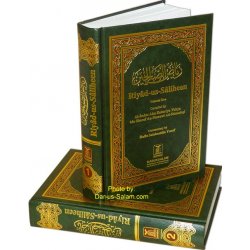
If a household owns one hadith collection besides a mushaf, this is usually it — and there is a good reason. Riyad-us-Saliheen (“The Gardens of the Righteous”), compiled by Imam Yahya ibn Sharaf An-Nawawi, gathers roughly 2,000 authentic hadith selected from the six major collections — Bukhari, Muslim, Abu Dawood, At-Tirmidhi, An-Nasa'i, and Ibn Majah — and arranges them by subject rather than by source. This two-volume hardback set presents the Arabic text alongside the English translation and commentary.
What Makes It Work
That single editorial decision — organizing by topic instead of by chain of narration — is why the book has been read continuously for over seven centuries. A reader with a question about a specific matter of conduct finds the relevant chapter directly; a reader with no question at all can open it anywhere and find something worth carrying through the day. It functions equally well as a reference work and as a daily reader, which is rare for a hadith collection of this depth.
The Range of Subjects
Sincerity of purpose, spending in the way of Allah, the rules of fasting, seeking knowledge, attending funerals, safeguarding the Qur'an — and on through the books of manners, the etiquette of eating, of dress, and of sleeping and sitting. Few single volumes cover this much ground on belief and conduct together.
This Edition
Commentary on the ahadith was added by Hafiz Salahuddin Yusuf of Pakistan, adapted from his original notes for the Urdu edition of the book. The English translation of both the hadith and the commentary was carried out by Dr. Muhammad Amin and Abu Usamah Al-Arabi bin Razduq. Presented as a handsome two-volume hardback with Arabic text alongside the English, this edition suits reading aloud, teaching, and reference alike.
Who Should Own It
This is a foundational text for any Muslim household, and a natural next step after the Qur'an and a basic seerah for anyone building a personal library. Teachers and study circles use it as a curriculum on its own; new students of hadith use it as their entry point into the subject before moving to the larger canonical collections.
Related Reading



 (15)
(15)