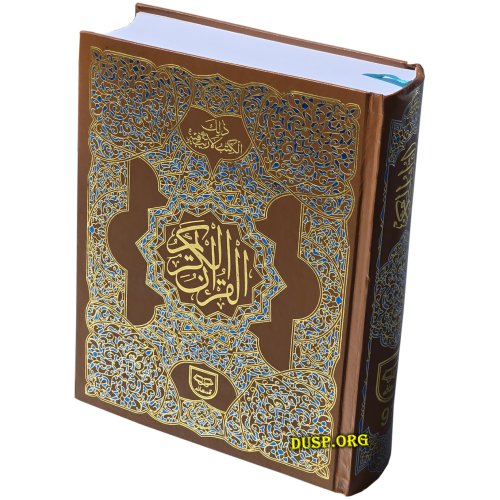
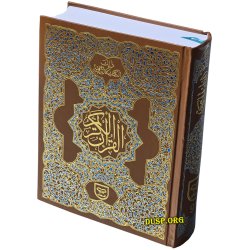
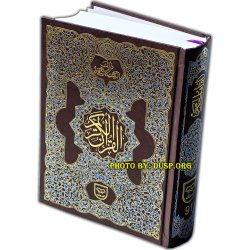
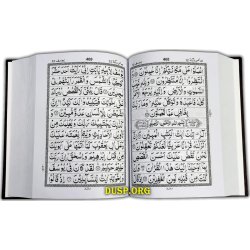
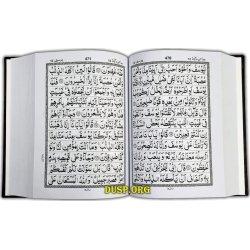
An 11-line Indo-Pak script Quran in bold type. This is the large, 7 x 10 in edition — the sweet spot for a child learning to read or an adult beginner — large enough to track a line without losing the place, without the bulk of the extra-large edition.
Why So Few Lines Per Page
Fewer lines means each one gets more vertical space, and the letters can be set considerably larger. At 11 lines the type is roughly twice the height of a standard 15-line mushaf.
The trade-off is length: the same Quran spread over more pages makes a thicker, heavier book. That is a reasonable price for someone who could not read the standard size at all.
Who Actually Needs This
Two groups, and they are further apart in age than you might expect.
Beginners and children, who lose their place on a dense page and need room between the lines to track where they are.
Elderly readers, for whom the alternative is not a smaller mushaf but no recitation at all. That is worth saying plainly — a large-print Quran is frequently what keeps a daily habit of fifty years going.
About the Indo-Pak Script
Also called Persian or Pakistani script, these are the letterforms taught across Pakistan, India and Bangladesh. They differ noticeably from the Uthmani script used in Arab editions, and a reader who learned one finds the other slower — particularly when reciting from memory.
If you or your children learned to read the Quran in the subcontinent, or in a madrasah following that tradition, this is the script to stay with.
Other 11-Line Editions in Persian / Indo-Pak Script
These share the same page layout as this edition — the largest text we carry — fewest lines per page, so each line gets roughly double the height of a standard mushaf. Because the pages break in the same places, a reader can move between them without disturbing his memorization.
Fewer lines means larger text, but the pages break differently — so anyone who has begun memorizing should stay with the line count he learned from. Also available in 13 line, 15 line and 16 and 17 line.


 (5)
(5)